

Economic Bulletin Issue 1, 2026
Summary
At its meeting on 5 February 2026, the Governing Council decided to keep the three key ECB interest rates unchanged. Its updated assessment reconfirmed that inflation should stabilise at its 2% target in the medium term. The economy remains resilient in a challenging global environment. Low unemployment, solid private sector balance sheets, the gradual rollout of public spending on defence and infrastructure, and the supportive effects of the past interest rate cuts are underpinning growth. At the same time, the outlook is still uncertain, owing particularly to ongoing global trade policy uncertainty and geopolitical tensions.
The Governing Council is determined to ensure that inflation stabilises at its 2% target in the medium term. It will follow a data-dependent and meeting-by-meeting approach to determining the appropriate monetary policy stance. In particular, the Governing Council’s interest rate decisions will be based on its assessment of the inflation outlook and the risks surrounding it, in light of the incoming economic and financial data, as well as the dynamics of underlying inflation and the strength of monetary policy transmission. The Governing Council is not pre-committing to a particular rate path.
Economic activity
The economy grew by 0.3% in the fourth quarter of 2025, according to Eurostat’s preliminary flash estimate. Growth has mainly been driven by services, notably in the information and communication sector. Manufacturing has been resilient despite the headwinds from global trade and geopolitical uncertainty. Momentum in construction is picking up, also supported by public investment.
The labour market continues to support incomes, even though demand for labour has cooled further. Unemployment stood at 6.2% in December, after 6.3% in November. Growing labour incomes together with a lower household saving rate should bolster private consumption. Government spending on defence and infrastructure should also contribute to domestic demand. Business investment should strengthen further, and surveys indicate that firms are increasingly investing in new digital technologies. At the same time, the external environment remains challenging, owing to higher tariffs and a stronger euro over the past year.
The Governing Council stresses the urgent need to strengthen the euro area and its economy in the present geopolitical context. Governments should prioritise sustainable public finances, strategic investment and growth-enhancing structural reforms. Unlocking the full potential of the European Single Market remains crucial. It is also vital to foster greater capital market integration by completing the savings and investments union and the banking union to an ambitious timetable, and to rapidly adopt the Regulation on the establishment of the digital euro.
Inflation
In January 2026 inflation declined to 1.7%, from 2.0% in December and 2.1% in November. Energy inflation dropped to ‑4.1%, after ‑1.9% in December and ‑0.5% in November, while food price inflation increased to 2.7%, from 2.5% in December and 2.4% in November. Inflation excluding energy and food eased to 2.2%, after 2.3% in December and 2.4% in November. Goods inflation edged up to 0.4%, whereas services inflation declined to 3.2%, from 3.4% in December and 3.5% in November.
Indicators of underlying inflation have changed little over recent months and remain consistent with the Governing Council’s 2% medium-term target. Negotiated wage growth and forward-looking indicators, such as the ECB’s wage tracker and the results of surveys on wage expectations, point to a continued moderation in labour costs. However, the contribution to overall wage growth from payments over and above the negotiated wage component remains uncertain.
Most measures of longer-term inflation expectations continue to stand at around 2%, supporting the stabilisation of inflation around the Governing Council’s target.
Risk assessment
The euro area continues to face a volatile global policy environment. A renewed increase in uncertainty could weigh on demand. A deterioration in global financial market sentiment could also dampen demand. Further frictions in international trade could disrupt supply chains, reduce exports and weaken consumption and investment. Geopolitical tensions, in particular Russia’s unjustified war against Ukraine, remain a major source of uncertainty. By contrast, planned defence and infrastructure spending, together with the adoption of productivity-enhancing reforms and the adoption of new technologies by euro area firms, may drive up growth by more than expected, including through positive effects on business and consumer confidence. New trade agreements and a deeper integration of the Single Market could also boost growth beyond current expectations.
The outlook for inflation continues to be more uncertain than usual on account of the volatile global policy environment. Inflation could turn out to be lower if tariffs reduce demand for euro area exports by more than expected and if countries with overcapacity increase further their exports to the euro area. Moreover, a stronger euro could bring inflation down beyond current expectations. More volatile and risk-averse financial markets could weigh on demand and thereby also lower inflation. By contrast, inflation could turn out to be higher if there were a persistent upward shift in energy prices, or if more fragmented global supply chains pushed up import prices, curtailed the supply of critical raw materials and added to capacity constraints in the euro area economy. If wage growth moderated more slowly, services inflation might come down later than expected. The planned boost in defence and infrastructure spending could also cause inflation to pick up over the medium term. Extreme weather events, and the unfolding climate and nature crises more broadly, could drive up food prices by more than expected.
Financial and monetary conditions
During the period from the Governing Council’s last monetary policy meeting on 18 December 2025, market rates came down, while global trade and geopolitical tensions temporarily increased financial market volatility. Bank lending rates for firms ticked up to 3.6% in December, from 3.5% in November, as did the cost of issuing market-based debt. The average interest rate on new mortgages again held steady, at 3.3% in December.
Bank lending to firms grew by 3.0% on a yearly basis in December, after 3.1% in November and 2.9% in October. Corporate bond issuance rose by 3.4% in December. According to the January 2026 bank lending survey for the euro area, firms’ demand for credit was up slightly in the fourth quarter of 2025, especially to finance inventories and working capital. At the same time, credit standards for business loans tightened again.
Mortgage lending grew by 3.0% in December, after 2.9% in November and 2.8% in October, in response to still rising demand for loans and an easing of credit standards.
Monetary policy decisions
The interest rates on the deposit facility, the main refinancing operations and the marginal lending facility were kept unchanged at 2.00%, 2.15% and 2.40% respectively.
The asset purchase programme and pandemic emergency purchase programme portfolios are declining at a measured and predictable pace, as the Eurosystem no longer reinvests the principal payments from maturing securities.
Conclusion
At its meeting on 5 February 2026, the Governing Council decided to keep the three key ECB interest rates unchanged. It is determined to ensure that inflation stabilises at its 2% target in the medium term. It will follow a data-dependent and meeting-by-meeting approach to determining the appropriate monetary policy stance. The Governing Council’s interest rate decisions will be based on its assessment of the inflation outlook and the risks surrounding it, in light of the incoming economic and financial data, as well as the dynamics of underlying inflation and the strength of monetary policy transmission. The Governing Council is not pre-committing to a particular rate path.
In any case, the Governing Council stands ready to adjust all of its instruments within its mandate to ensure that inflation stabilises sustainably at its medium-term target and to preserve the smooth functioning of monetary policy transmission.
1 External environment
Global economic growth has remained resilient overall, driven by robust growth in the United States and China in the third quarter of 2025. This growth is expected to have softened slightly in the fourth quarter, partly reflecting the US Government shutdown in October and November, although consumption growth in the United States likely remained robust. Global import growth slowed in the third quarter and is expected to remain below historical averages in the near term, owing in part to continued trade policy uncertainty. Strong trade growth in high-tech products, including those related to AI, remains a bright spot in an otherwise subdued short-term trade outlook. Headline inflation across member countries of the Organisation for Economic Co-operation and Development (OECD) was broadly stable in November.
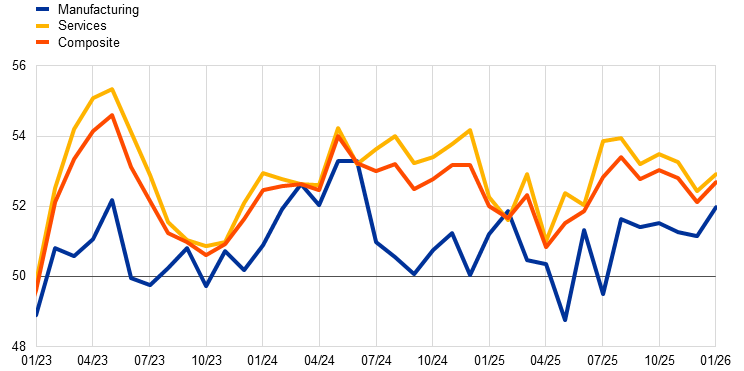
Global economic growth has remained resilient overall, despite some expected softening in the fourth quarter of 2025. National accounts data point towards robust growth in the third quarter, mainly on account of the United States and China, while the Indian economy also grew strongly. This stronger than expected growth is expected to have softened slightly in the fourth quarter, influenced in part by the US Government shutdown during that period. The global composite output Purchasing Managers’ Index (PMI; excluding the euro area) declined from the third to the fourth quarter of 2025, mainly owing to weakening services, but remained resilient and in expansionary territory. In January the PMI experienced an uptick to 52.7, driven by broad-based improvements across sectors (Chart 1). Across countries, the composite output PMI increased markedly in the United Kingdom and Japan in January, while improving marginally in the United States and China.
Chart 1
Global output PMI (excluding the euro area)
(diffusion indices)
Sources: S&P Global Market Intelligence and ECB staff calculations.
Notes: The horizontal line at 50 marks the neutral baseline dividing expansion and contraction. The latest observations are for January 2026.
Global import growth slowed in the third quarter of 2025 and is expected to remain below historical averages in the near term. Weakening high-frequency trade data, particularly for the United States, suggest that global import growth is likely to remain subdued in the near term. Moreover, tariff threats and volatile trade policies continue to weigh on world trade dynamics. High-tech products, including those related to AI, remain a bright spot in an otherwise subdued short-term trade outlook. Based on nominal global trade data up to October 2025, trade in high-tech goods, as defined by Eurostat, was growing at an annual rate of 18% compared with the first ten months of 2024. Trade in AI-related high-tech goods, such as microchips and automatic data processing machines, was growing even faster, at an annual rate of 35%. Excluding the euro area, the main net exporters of high-tech goods are China, South Korea and the members of the Association of Southeast Asian Nations. The largest main net importer is the United States, with US imports growing by 65% year on year in the first ten months of 2025.
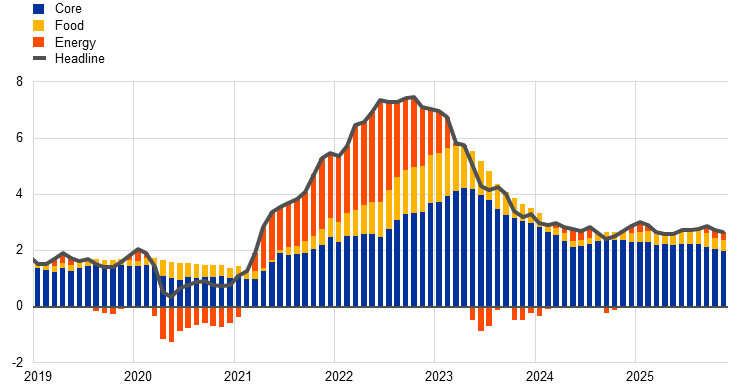
Headline inflation across OECD member countries excluding Türkiye was broadly stable in November. The annual rate of consumer price index (CPI) inflation across OECD member countries excluding Türkiye remained unchanged, after rounding, at 2.7% in November. Small decreases in the contribution from the food and core components were partly offset by a slightly higher contribution from energy prices (Chart 2). Globally, excluding the euro area, disinflation seems to be stalling. CPI headline inflation was stable in the second half of 2025, as rising inflation in China offset disinflation in other emerging market economies. Meanwhile, inflation in advanced economies moved little and global core inflation dropped only marginally.
Chart 2
OECD CPI inflation
(year-on-year percentage changes, percentage point contributions)
Sources: OECD and ECB staff calculations.
Notes: The OECD aggregate includes euro area countries that are OECD members and excludes Türkiye. It is calculated using OECD CPI annual weights. The latest observations are for November 2025.
Oil and gas prices both increased, driven by geopolitical developments and concerns over gas storage levels respectively, while food prices fell and metal prices rose. Since the last Governing Council meeting, oil prices have climbed by 13% overall. They initially showed only a limited increase in response to the US capture of President Nicolás Maduro in Venezuela but were subsequently driven up by the escalation of protests in Iran and the prospect of US intervention. The muted response to developments in Venezuela reflects the country’s modest role in global oil supply. Venezuela only produces around one million barrels of oil per day, or 1% of global output, and the potential to increase supply remains limited. The limitations stem from the predominance of heavy, sour crude oil in Venezuela. Although compatible with US refineries, this oil is difficult to extract, especially given the dilapidated state of the country’s oil infrastructure. Turning to European gas prices, these rose by a sharp 22%. Cold weather in Europe led to a rapid drawdown of inventories, bringing them close to the lower end of their historical range. Storage concerns have been exacerbated by downward pressure on long-dated gas futures for winter 2026-27, reflecting successive waves of liquified natural gas supply from the United States and Qatar. As futures prices offer little scope for profitable resale later, gas storage operators currently have limited incentives to inject gas. Food prices edged down by 7% owing to expectations for a strong supply of corn in 2026, together with weak demand for cocoa beans. By contrast, industrial metal prices increased by 10%, bolstered by renewed expectations for US tariffs on copper, which prompted traders to accelerate shipments to the United States.
US real GDP growth accelerated in the third quarter of 2025 to 1.1% quarter on quarter. Economic activity was driven by private consumption and net exports, while growth in private fixed investment moderated. The US Government shutdown during the fourth quarter is likely to have had a negative effect on growth. Nonetheless, monthly data up to November 2025 suggest consumption momentum remained strong in the fourth quarter. By contrast, the US labour market continued to cool. Private-sector job growth remained low and was mostly concentrated in health care and social assistance. Aggregate job growth in other industries was close to zero, with retail and manufacturing shedding jobs. US CPI headline and core inflation, at 2.7% and 2.6% respectively, remained unchanged in December. However, these figures could be biased down on account of impaired data collection during the Government shutdown, particularly for rent inflation, as missing observations were replaced by imputations. Goods inflation has surprised to the downside, though it remains in positive territory.
China achieved its growth target of 5% in 2025, but its expansion remains reliant on foreign demand. Quarterly GDP growth reached 1.2% in the fourth quarter of 2025, up slightly from 1.1% in the third quarter. This was mainly on the back of a higher contribution from net trade which exceeded market expectations. Recent policy signals point to continued fiscal support in 2026, consistent with the Chinese authorities’ stated objective of supporting domestic demand and achieving a similar growth target in 2026. In 2025 fixed asset investment experienced its first annual contraction since the early 1990s, resulting from efforts to reduce both overcapacity and local government debt. The property market remains a drag on the economy and continues to weigh on consumer confidence and spending. Strong exports, mainly to emerging market economies, led to a record trade surplus of USD 1.2 trillion in 2025. Export growth is expected to continue to support the Chinese economy in 2026, barring a renewed escalation in trade tensions with the United States. Annual Chinese consumer price inflation edged up to 0.8% in December, from 0.7% in November, driven mainly by higher food prices and base effects. Annual core inflation remained unchanged at 1.2%. Looking beyond temporary factors, sluggish domestic demand and industrial overcapacity are expected to continue to fuel intense price competition among firms, while the impact on inflation of efforts to reduce overcapacity is yet to fully materialise.
Economic momentum in the United Kingdom remained weak in the final quarter of 2025. Between August and November GDP expanded by 0.1% overall, driven by the services sector and a normalisation in car production following disruptions triggered by a cyberattack in September. PMI data up to January 2026 confirm weak economic momentum towards the end of 2025 and a limited pick-up at the start of 2026. Headline inflation increased to 3.4% in December from 3.2% in the previous month, but stayed below the recent peak of 3.8% in the third quarter. Core inflation remained at 3.2%. Data up to November show that private regular earnings growth has continued to ease, albeit from elevated levels.
2 Economic activity
Euro area real GDP increased by 0.3%, quarter on quarter, in the fourth quarter of 2025, marking positive growth across all quarters, despite the numerous challenges arising throughout the year. Short-term indicators and available country data point to a continued positive contribution from domestic demand and a weaker contribution from net exports. At the sectoral level, growth has mainly been driven by services, notably in the information and communication sector. Manufacturing likely bottomed out by the end of 2025, demonstrating resilience to the headwinds from global trade and geopolitical uncertainty. Momentum in construction is picking up, also supported by public investment. Surveys continue to point to a dual-speed recovery with services growing more strongly than manufacturing. Looking further ahead, barring any unexpected short-term volatility, euro area activity is expected to gradually recover, supported by domestic demand. Consumption should benefit from rising real incomes and a gradually declining saving rate. Increased business investment, alongside substantial government spending on infrastructure and defence, should also underpin the economic expansion. Nonetheless, challenges related to global trade disruptions and escalating geopolitical tensions are likely to remain headwinds for euro area growth going forward.
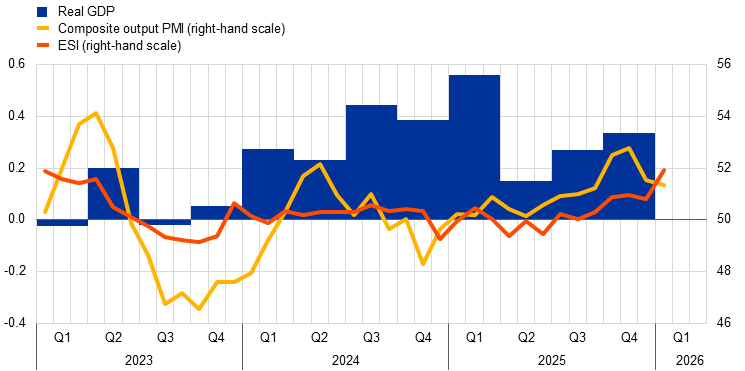
Euro area GDP continued to rise in the fourth quarter of 2025, according to Eurostat’s preliminary flash estimate. Real GDP increased by 0.3%, quarter on quarter, in the fourth quarter of 2025, marking positive growth across all quarters of the year (Chart 3). In 2025 as a whole, GDP is estimated to have risen by 1.5%, up from 0.8% in 2024.[1] Growth momentum strengthened in 2025 amid a number of global challenges, related to geopolitics and trade, highlighting the resilience of the euro area economy. Although the expenditure breakdown for the fourth quarter is not yet available, short-term indicators and available country data suggest that domestic demand made a positive contribution to growth, while net exports were more subdued. Growth has mainly been driven by services, notably in the information and communication sector. Manufacturing has shown resilience to the headwinds from global trade and geopolitical uncertainty. Momentum in construction is picking up, also supported by public investment. Growth dynamics across countries in the fourth quarter of 2025 were less heterogenous compared with earlier quarters. The fourth quarter outcome for the euro area generates a carry-over effect of 0.4% for annual growth in 2026.[2]
Chart 3
Euro area real GDP, composite output PMI and ESI
(left-hand scale: quarter-on-quarter percentage changes; right-hand scale: diffusion index)
Sources: Eurostat, European Commission, S&P Global Market Intelligence and ECB calculations.
Notes: The two lines indicate monthly developments; the bars show quarterly data. For the composite output Purchasing Managers’ Index (PMI), the horizontal line at 50 marks the neutral baseline dividing expansion and contraction. The European Commission Economic Sentiment Indicator (ESI) has been standardised and rescaled to have the same mean and standard deviation as the composite output PMI. The latest observations are for the fourth quarter of 2025 for real GDP and January 2026 for the composite output PMI and the ESI.
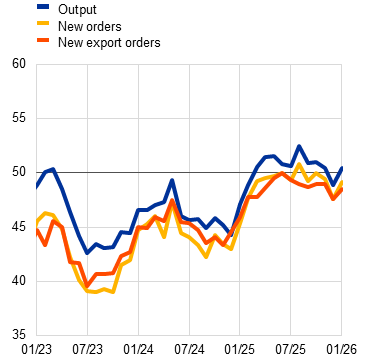
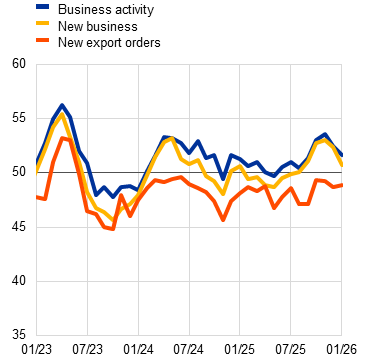
The limited data available for the first quarter of 2026 point to continued strength in the services sector and a bottoming out of the manufacturing sector. The composite output Purchasing Managers’ Index (PMI) remained broadly stable between December 2025 and January 2026, indicating continued moderate growth, albeit at a somewhat slower rate than in the fourth quarter of last year (Chart 4, panel a). The manufacturing output PMI edged up slightly from the fourth quarter of 2025, to 50.5 in January, still signalling slow growth or stagnating activity. Despite showing signs of bottoming out, there is no indication of a clear recovery path ahead in the manufacturing sector owing to the protracted adverse effects from higher tariffs, still-heightened uncertainty and the recent strengthening of the euro. Other indicators, such as the new orders PMI, paint a similar picture of a very muted short-term outlook for the industrial sector. Meanwhile, the services PMI business activity index declined from an average of 53.0 in the fourth quarter to 51.6 in January. While this suggests a slowdown, the growth rate in services remains stronger than in manufacturing, continuing to support the notion of a dual-speed recovery. The ECB’s recent contacts with non-financial companies corroborate this outlook (see Box 5). On balance, contacts reported gradually improving momentum and confidence in recent months, albeit with notable variations across sectors and countries. Growth continues to be driven primarily by services activity, supported by consumer spending on services rather than on goods, as well as strong growth in business spending in digital (in particular AI-related) services.
Chart 4
PMI indicators across sectors of the economy
a) Manufacturing |
b) Services |
|---|---|
(diffusion indices) |
(diffusion indices) |
 |
 |
Source: S&P Global Market Intelligence.
Notes: The horizontal line at 50 marks the neutral baseline dividing expansion and contraction. The latest observations are for January 2026.
The labour market continues to support income growth, even though demand for labour has cooled further. Employment increased by 0.2% in the third quarter of 2025 and total hours worked increased by 0.4%, allowing for a small recovery in average hours worked (Chart 5). Year on year, employment growth continued to decelerate. Meanwhile, new jobs continue to be filled by people entering the labour force. Growth in the labour force slowed to 0.0% in the third quarter in quarter-on-quarter terms, although it still increased by 0.9% in year-on-year terms. At the same time, the unemployment rate stood at 6.2% in December, after reaching 6.3% in November, and the job vacancy rate declined to 2.2% in the third quarter, down from the peak of 3.3% seen in the second quarter of 2022.
Chart 5
Euro area employment, PMI assessment of employment and unemployment rate
(left-hand scale: quarter-on-quarter percentage changes, diffusion index; right-hand scale: percentages of the labour force)

Sources: Eurostat, S&P Global Market Intelligence and ECB calculations.
Notes: The two lines indicate monthly developments, while the bars show quarterly data. The PMI is expressed in terms of the deviation from 50, then divided by 10 to gauge quarter-on-quarter employment growth. The latest observations are for the third quarter of 2025 for euro area employment, January 2026 for the PMI assessment of employment and December 2025 for the unemployment rate.
Short-term labour market indicators point to weak employment growth in the fourth quarter of 2025. The monthly composite PMI employment indicator averaged 50.5 in the fourth quarter, suggesting weak employment growth. Data for January show a deterioration in employment perceptions. The composite indicator declined from 50.4 in December to 49.9 in January, driven by the services sector, which fell from 51.3 to 50.5. By contrast, the PMI employment indicator for manufacturing increased from 47.7 in December to 48.1 in January.
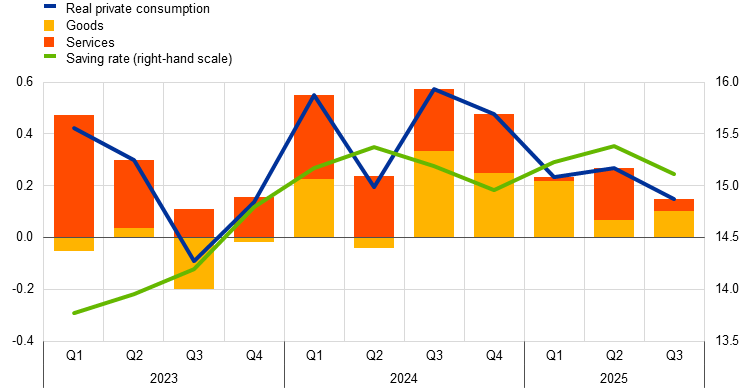
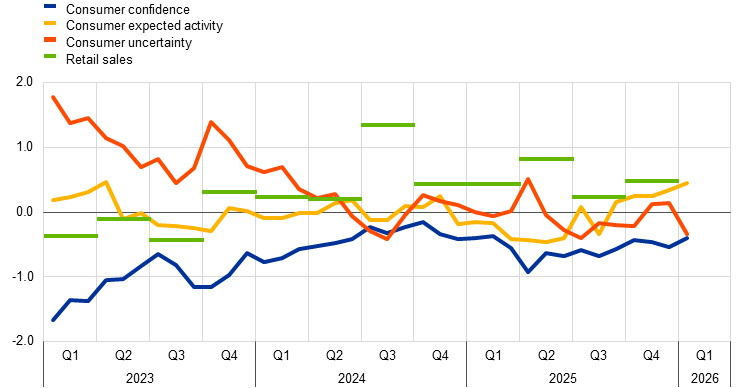
Private consumption growth likely strengthened in the fourth quarter of 2025 and is expected to remain positive in early 2026, as signalled by rising retail sales, consumer confidence and consumer expected activity. Consumption growth slowed in the third quarter reflecting weaker momentum in services and non-durable goods, partly offset by stronger demand for durable and semi-durable goods (Chart 6, panel a). The household saving rate declined slightly to 15.1% in the third quarter, as consumption outpaced income, but remained at a historically high level. High-frequency indicators point to strengthening momentum in private consumption in the fourth quarter (Chart 6, panel b). Retail sales growth in October and November improved compared with the third quarter. The European Commission’s consumer confidence indicator remains below its historical average but continued to recover in the fourth quarter, largely driven by improvements in household expectations about their personal financial situation and the overall economic situation in the next 12 months. In addition, “consumer expected activity”, a consumption-weighted aggregate index based on the European Commission’s business expectations about activity over the next three months, improved in the fourth quarter, standing well above its long-term average level. This assessment is further supported by the ECB Consumer Expectations Survey, which indicates increasing consumer confidence, as well as the recent contacts by the ECB with non-financial companies, which signal robust growth in services consumption (see Box 5). Looking ahead, private consumption should continue to strengthen, amid solid balance sheets and real income gains. However, subdued employment growth and lending activity, together with prolonged – albeit declining – uncertainty among households, could weigh on household spending and contribute to a persistently elevated saving rate (see Box 3).
Chart 6
Household consumption and savings; consumer confidence, expected activity and uncertainty, and retail sales
a) Household consumption and savings
(quarter-on-quarter percentage changes, percentage point contributions; percentages of gross disposable income)
b) Consumer confidence, uncertainty and expectations, and retail sales
(standardised percentage balances; retail sales: quarter-on-quarter percentage changes)
Sources: Eurostat, European Commission and ECB calculations.
Notes: In panel a), the levels of real domestic goods and services consumption are scaled to add up to the level of real private consumption in the main national accounts. In panel b), “consumer expected activity” refers to a weighted average of business expectations for the next three months with regard to production for manufacturing, employment for construction, business for trade and demand for services from the European Commission business survey, weighted according to the sectoral shares in euro area private consumption from the FIGARO input-output tables for 2023. “Consumer uncertainty” stands for the European Commission Consumer Economic Uncertainty Index. All series are standardised for the whole sample from January 1999, except “consumer uncertainty”, which is standardised for the whole sample from April 2019, owing to data availability. The latest observations are for the third quarter of 2025 for panel a) and for December 2025 for retail sales and January 2026 for all other items, for panel b).
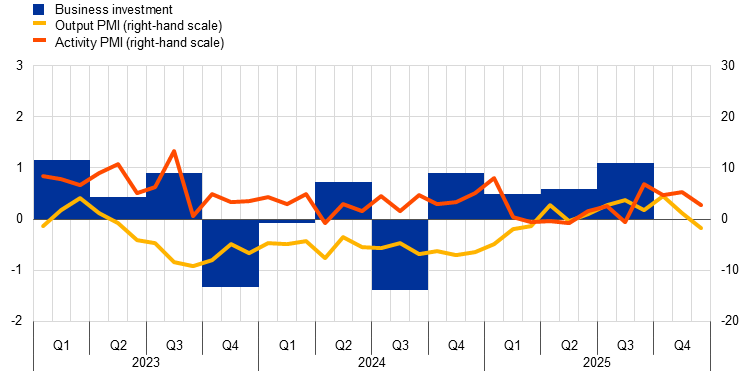
Business investment is likely to have continued to grow at the turn of the year. In the third quarter of 2025 business investment (excluding Irish intellectual property products) rose by 1.1%, quarter on quarter, with both tangibles and intangibles growing robustly. Tangible investment growth appears to have continued to increase moderately in the fourth quarter of 2025, as evidenced by rising capital goods production up to November compared with the previous quarter. Meanwhile, the output PMI for capital goods dropped below 50 in December, pointing to some slowdown at the turn of the year (Chart 7, panel a). By contrast, intangible investment maintained strong momentum. This is reflected in a solid increase in digital services production observed in October compared with the third quarter, while the activity PMI for intangible services remained above 50 throughout the fourth quarter. Corporate contacts reported a gradually improving investment outlook in January, especially for projects related to electrification, data centres, energy and defence (see Box 5). Among key investment drivers, profits are normalising, confidence has improved and demand dynamics have kept close to their historical norms in recent quarters, while credit conditions have tightened somewhat, according to the January 2026 euro area bank lending survey. Looking ahead, a continued rise in demand, profits and confidence, along with fiscal support and solid balance sheets should underpin investment in the coming quarters.
Chart 7
Real investment dynamics and survey data
a) Business investment
(quarter-on-quarter percentage changes; percentage balances and diffusion index)
b) Housing investment
(quarter-on-quarter percentage changes; percentage balances and diffusion index)
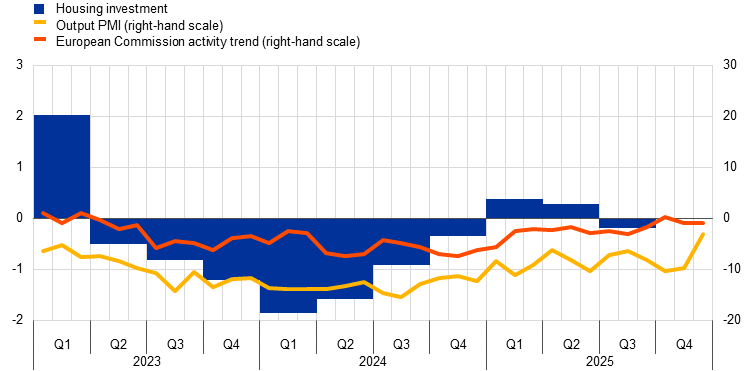
Sources: Eurostat, European Commission, S&P Global Market Intelligence and ECB calculations.
Notes: The lines indicate monthly developments, while the bars refer to quarterly data. The PMIs are expressed in terms of the deviation from 50. In panel a), business investment is measured by non-construction investment excluding Irish intangibles. The output PMI indicator refers to the capital goods sector and the activity PMI refers to computer programming, consultancy and related activities. In panel b), the line for the European Commission’s activity trend indicator refers to the weighted average of the building and specialised construction sectors’ assessment of the trend in activity over the preceding three months, rescaled to have the same standard deviation as the PMI. The line for output PMI refers to housing activity. The latest observations are for the third quarter of 2025 for investment and December 2025 for the PMIs and the European Commission’s indicator.
Housing investment is estimated to have resumed its recovery in the fourth quarter of 2025 and early 2026. After contracting marginally by 0.2%, quarter on quarter, in the third quarter of 2025, short-term indicators suggest that this decline has been temporary. Production in building construction and specialised construction activities increased by 0.7% in the fourth quarter of 2025 compared with the third quarter. Survey indicators of construction activity confirm this positive trend: the European Commission’s activity trend indicator improved gradually and the PMI for housing output increased significantly, albeit still signalling a contraction (Chart 7, panel b). Furthermore, on balance, the ECB’s recent contacts with construction firms and their suppliers point to moderate improvements in residential building activity. Taken together, these developments suggest a continued recovery in housing demand. In response to this recovering demand, an increasing number of construction firms have reported labour supply constraints in recent quarters. Meanwhile, the European Commission business survey shows that employment expectations in the construction sector increased in the fourth quarter of 2025, reaching their highest level since the second quarter of 2023. This signals that firms anticipate a sustained recovery in demand in the short term. At the same time, mortgage rate expectations edged slightly higher in December according to the Consumer Expectations Survey, in line with a plateauing share of survey respondents who consider housing as a good investment seen in recent months. Nonetheless, as the effects of recent monetary policy easing have yet to fully feed through to housing investment (see Box 4), its gradual recovery is expected to continue beyond the short term.
Euro area exports remain constrained by US tariffs, a strong euro and weak global demand, declining by 0.1% over three months to October 2025. The overall increase in exports to the United States resulted from a sharp rise in Irish exports of pharmaceutical products related to weight-loss drugs in September, which amply offset the decline in other exports to that country. Exports to other destinations remained subdued, amid exchange rate appreciation and continued losses in export market shares across destinations and sectors. Forward-looking indicators are signalling a continued weakness in manufacturing export orders. Euro area import volumes marked a significant decline of 1.1% over three months to October 2025, with the exception of imports from China which continue to be supported by very competitive pricing, manufacturing overcapacity and a depreciation of the exchange rate against the euro. At the same time, Chinese export restrictions highlight supply chain vulnerabilities, as China remains a key supplier of the rare earth materials critical for euro area industries, while survey indicators point to some lengthening of suppliers’ delivery times, particularly in sectors that depend on external suppliers for critical components.
Beyond the short term, barring any unexpected volatility, euro area activity is expected to continue its gradual recovery. Over the longer projection horizon, domestic demand is expected to remain the main driver of growth, as reflected in the December 2025 Eurosystem staff macroeconomic projections for the euro area. Growing labour incomes together with a lower household saving rate should bolster private consumption. Business investment should strengthen further, and surveys indicate that firms are increasingly investing in new digital technologies. Moreover, substantial government spending on infrastructure and defence should also contribute to domestic demand. However, the external environment remains challenging owing to higher tariffs and a stronger euro over the past year.
3 Prices and costs
Annual euro area headline inflation decreased to 1.7% in January 2026, down from 2.0% in December 2025, owing to declines in energy inflation and inflation excluding energy and food.[3] Indicators of underlying inflation have changed little over recent months and remain consistent with the Governing Council’s 2% medium-term target. Annual growth in compensation per employee stood at 4.0% in the third quarter of 2025, unchanged from the previous quarter. Negotiated wage growth and forward-looking indicators, such as the ECB wage tracker and the results of surveys on wage expectations, point to a continued moderation in labour costs. Most measures of longer-term inflation expectations continue to stand at around 2%, supporting the stabilisation of inflation around the target.
Annual euro area headline inflation, as measured in terms of the Harmonised Index of Consumer Prices (HICP), fell to 1.7% in January 2026, down from 2.0% in December 2025 (Chart 8). This decrease reflects a decline in energy inflation and in HICP excluding energy and food (HICPX) inflation. In the fourth quarter of 2025 euro area headline inflation stood at 2.1%, broadly in line with the December 2025 Eurosystem staff macroeconomic projections for the euro area.
Chart 8
Headline inflation and its main components
(annual percentage changes; percentage point contributions)
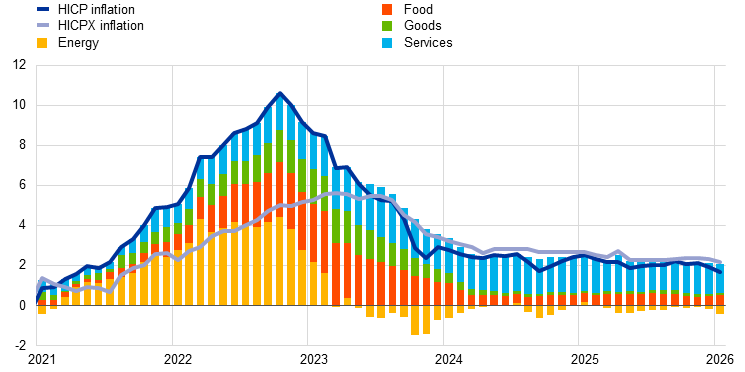
Sources: Eurostat and ECB calculations.
Notes: “Goods” refers to non-energy industrial goods. HICPX stands for HICP excluding energy and food. The latest observations are for January 2026 (flash estimate).
Energy inflation remained negative in January 2026, falling further to ‑4.1%, down from ‑1.9% in December 2025. This decline was driven primarily by a large downward base effect, as energy prices rose month on month, but at a slower pace than in January 2025. Data available up to December 2025 on the main energy sub-components show a fall in the annual growth rates of prices for electricity, gas and transportation fuels, with transportation fuels recording the sharpest drop.
Food inflation saw an uptick to 2.7% in January 2026, up from 2.5% in December 2025. This increase was driven by higher unprocessed food inflation, which rose to 4.2% in January from 3.5% in December, reflecting a stronger non-seasonally adjusted month-on-month development than is typical for January. Over the same period, processed food inflation remained unchanged at 2.1%.
HICPX inflation decreased to 2.2% in January 2026, down from 2.3% in December 2025. This decline reflects a lower annual rate of growth in services, which was partly offset by a slight increase in that of non-energy industrial goods (NEIG). Services inflation declined further to 3.2% in January, down from 3.4% in December and 3.5% in November. According to data up to December, this slowdown in services inflation was due mainly to declines in annual growth rates in the recreation sub-component, particularly in package holidays and accommodation services, which were partly offset by an increase in the annual rate of growth in prices for transportation services. By contrast, NEIG inflation edged up to 0.4% in January after falling to 0.3% in December from 0.5% in November. The relatively low growth rate in December compared with November was due to a decline in the annual rates of growth in prices for semi-durable goods and non-durable goods.
Indicators of underlying inflation remained consistent with the Governing Council’s 2% medium-term target in December 2025 and January 2026 (Chart 9). In December 2025 the indicator values ranged from 2.0% to 2.6%. From November to December, most exclusion-based measures of inflation either went down by 0.1 percentage points or remained unchanged. HICPX excluding travel-related items, clothing and footwear remained unchanged at 2.5%. Over the same period, the trimmed means decreased by 0.2 percentage points. Regarding the model-based measures, the Persistent and Common Component of Inflation was unchanged at 2.0%, and the Supercore indicator, which comprises HICP items sensitive to the business cycle, remained at 2.5% for the sixth consecutive month. Domestic inflation, which comprises items with a low import content, declined slightly to 3.5% in December, down from 3.6% in November. Data that are already available for January 2026 show that most exclusion-based measures fell by 0.1 percentage points compared with December 2025. HICP excluding energy fell from 2.4% in December to 2.3% in January.
Chart 9
Indicators of underlying inflation
(annual percentage changes)
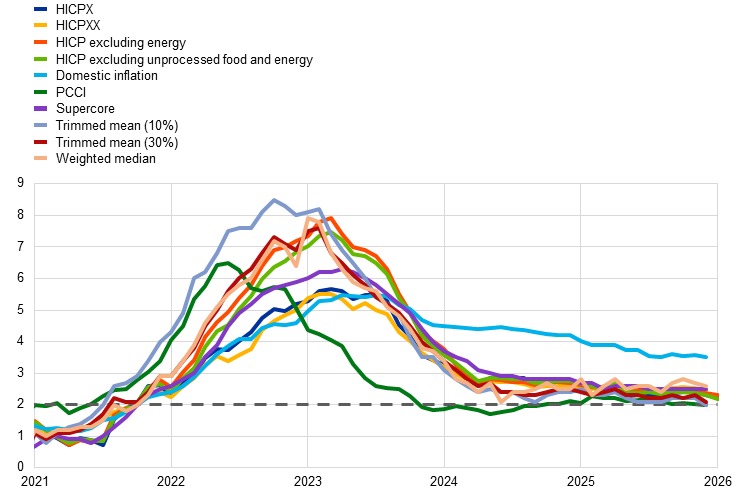
Sources: Eurostat and ECB calculations.
Notes: HICPX stands for HICP excluding energy and food; HICPXX stands for HICPX excluding travel-related items, clothing and footwear; PCCI stands for Persistent and Common Component of Inflation. The grey dashed line represents the Governing Council’s inflation target of 2% over the medium term. The latest observations are for January 2026 (flash estimate) for HICPX, HICP excluding energy and HICP excluding unprocessed food and energy, and December 2025 for the remaining measures.
The latest indicators of pipeline pressures suggest that inflationary pressures on goods prices are broadly unchanged (Chart 10). At the early stages of the pricing chain, producer price inflation for domestic sales of intermediate goods increased to 0.8% in December, up from 0.4% in November, while import price inflation for intermediate goods remained unchanged at ‑0.8% in November for the third consecutive month. At the later stages of the pricing chain, for non-food consumer goods, the annual growth rate of producer prices was unchanged at 1.8% in December, while that of import prices slipped further into negative territory, from ‑1.6% in October to ‑2.0% in November. For manufactured food, the annual growth rate of producer prices decreased to 0.4% in December, from 0.6% in November and that of import prices slowed from 2.7% in October to 1.1% in November, pointing to easing cost pressures amid falling international food commodity prices. Overall, weaker import price dynamics reflected the appreciation of the euro and downward price pressures due to imports of cheaper goods from China, while domestic producer price dynamics remained more persistent.
Chart 10
Indicators of pipeline pressures
(annual percentage changes)
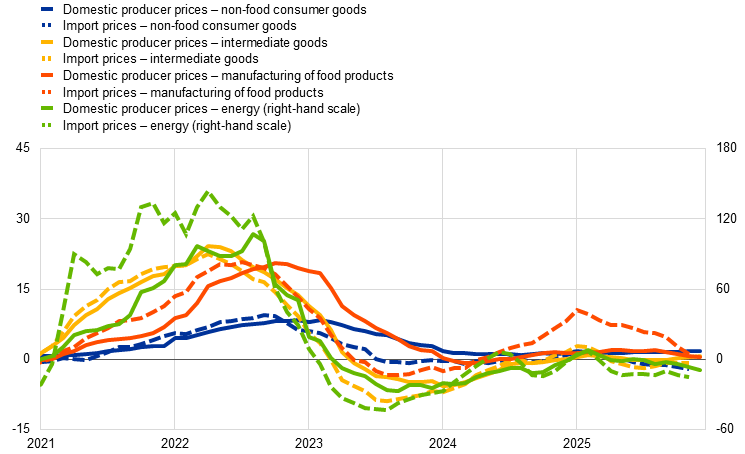
Sources: Eurostat and ECB calculations.
Note: The latest observations are for December 2025 for domestic producer prices and November 2025 for import prices.
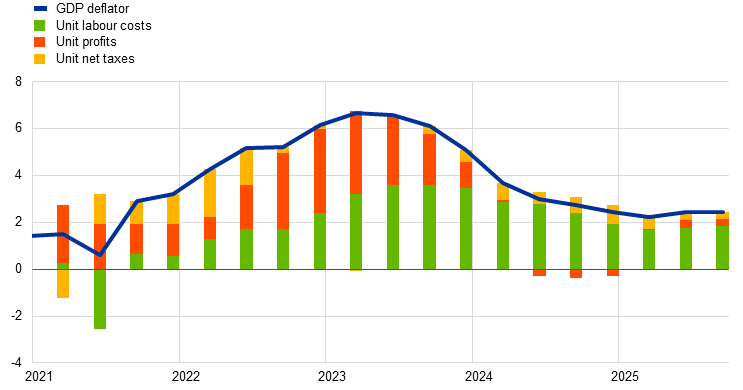
Domestic cost pressures, as measured by growth in the GDP deflator, were unchanged in the third quarter of 2025, after declining continuously for two years (Chart 11). The annual growth rate of the GDP deflator remained broadly stable at 2.4% in the third quarter of 2025, reflecting unchanged contributions from unit labour costs and unit profits, but a slightly lower contribution from unit taxes. The annual growth rate of unit labour costs increased to 3.3% in the third quarter, up from 3.1% in the second quarter. This was due to a decrease in labour productivity over the same period, down to 0.7% from 0.8%, while the growth rate for compensation per employee remained unchanged at 4.0%. The decline in negotiated wage growth from 4.0% in the second quarter to 1.9% in the third quarter was offset by an increase in the wage drift component, from ‑0.3 percentage points to 1.9 percentage points over the same period. Looking ahead, the ECB wage tracker, which has been updated with data on wage agreements negotiated up to mid-January 2026, suggests that wage growth pressures will ease, with wage growth standing at 3.1% in the fourth quarter of 2025 and 3.0% for the whole year, before moderating further to 2.7% over 2026.[4] This moderation is also confirmed by the latest survey indicators on wage growth, such as the results of the ECB Corporate Telephone Survey, which imply that wage growth is expected to stand at 3.2% in 2025 (0.1 percentage points lower than in the previous survey round) and fall further to 2.7% in 2026 (0.1 percentage points higher than in the previous survey round) and 2.5% in 2027.[5]
Chart 11
Breakdown of the GDP deflator
(annual percentage changes; percentage point contributions)
Sources: Eurostat and ECB calculations.
Notes: Compensation per employee contributes positively to changes in unit labour costs. Labour productivity contributes negatively. The latest observations are for the third quarter of 2025.
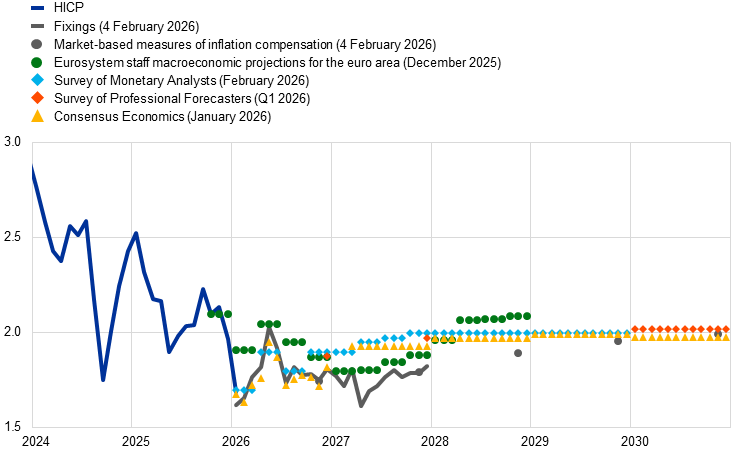
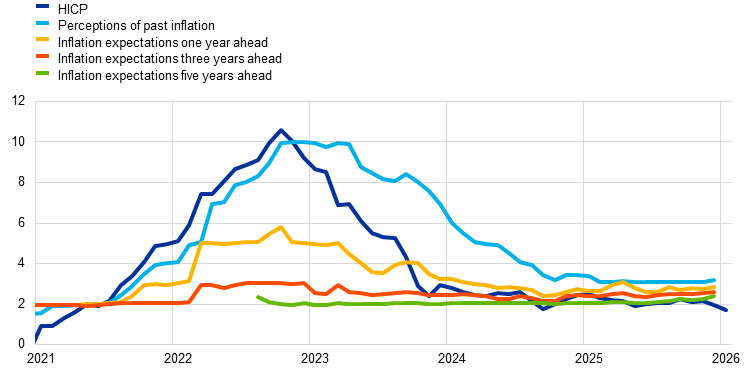
Longer-term inflation expectations among professional forecasters and monetary analysts remained stable at around 2%, while short-term consumer inflation expectations and perceptions moved broadly sideways in December 2025. The median of longer-term inflation expectations in the ECB Survey of Monetary Analysts for February 2026 and in the ECB Survey of Professional Forecasters for the first quarter of 2026 remained unchanged at 2% (Chart 12, panel a). As regards short-term consumer inflation expectations and perceptions, according to the December 2025 ECB Consumer Expectations Survey, the median rate of perceived inflation over the previous 12 months stood at 3.2%, which is 0.1 percentage points higher than in November. Median expectations for inflation over the next 12 months remained unchanged from November, at 2.8%, while median inflation expectations three years ahead increased slightly to 2.6%, up from 2.5% in the previous month (Chart 12, panel b). Expectations for inflation five years ahead rose to 2.4% from 2.2% over the same period.
Chart 12
Headline inflation, inflation projections and expectations
a) Headline inflation, market-based measures of inflation compensation, inflation projections and survey-based indicators of inflation expectations
(annual percentage changes)
b) Headline inflation and ECB Consumer Expectations Survey
(annual percentage changes)
Sources: Eurostat, LSEG, Consensus Economics, ECB (SMA, SPF, CES), Eurosystem staff macroeconomic projections for the euro area, December 2025 and ECB calculations.
Notes: In panel a), the market-based measures of inflation compensation series is based on the one-year spot rate, the one-year forward rate one year ahead, the one-year forward rate two years ahead, the one-year forward rate three years ahead and the one-year forward rate four years ahead. The observations for market-based measures of inflation compensation are for 4 February 2026. Inflation fixings are swap contracts linked to specific monthly releases in euro area year-on-year HICP inflation excluding tobacco. The Survey of Professional Forecasters (SPF) for the first quarter of 2026 was conducted between 7 and 12 January 2026. The Survey of Monetary Analysts (SMA) for February 2026 was conducted between 19 and 21 January. The cut-off date for the Consensus Economics long-term forecasts was 12 January 2026. The December 2025 Eurosystem staff macroeconomic projections for the euro area were finalised on 3 December 2025, and the cut-off date for the technical assumptions was 26 November 2025. In panel b), the lines for the Consumer Expectations Survey (CES) represent the median rates. The latest observations are for January 2026 (flash estimate) for HICP and December 2025 for the remaining measures.
Since the Governing Council’s meeting on 18 December 2025, market-based measures of inflation compensation have increased for the near term but continue to signal inflation of slightly under 2%, while longer-term expectations remain well anchored (Chart 12, panel a). During the review period, inflation fixings, which are swap contracts linked to the HICP excluding tobacco, edged up for the first half of 2026 and were higher for the second half of the year on account of higher energy and industrial metal prices. This implies that investors expected inflation to bottom out in first months of the year, before rebounding to an average of around 1.8% over the whole year. Furthermore, the one-year forward inflation-linked swap rate one year ahead stood at 1.8%. Longer-term market-based inflation expectations remained well anchored to the Governing Council’s inflation target, as reflected in the five-year forward inflation-linked swap rate five years ahead, adjusted for inflation risk premia, which stood close to 2%.
4 Financial market developments
Euro area financial markets experienced bouts of volatility during the review period from 18 December 2025 to 4 February 2026. Interest rate expectations moved down amid renewed trade and geopolitical tensions. However, as these tensions abated, the decrease in rate expectations was partially reversed. Overall, the risk-free forward curve ended the review period slightly lower at short maturities, while suggesting that markets were not anticipating any policy rate changes in 2026. Medium and long-term nominal risk-free rates in the euro area declined somewhat over the review period, whereas sovereign bond spreads were generally stable and continued to be supported by resilient economic growth and robust demand for higher-yield sovereign bonds. Equity markets on both sides of the Atlantic came under temporary downward pressure from rising geopolitical tensions. But euro area equities subsequently recovered and increased overall during the review period. Corporate bond spreads narrowed slightly further, remaining compressed from a historical perspective. In foreign exchange markets, the euro appreciated slightly against the US dollar but weakened slightly on a trade-weighted basis.
Euro area risk-free forward rates edged down at short maturities and also settled moderately lower at longer maturities. The benchmark euro short-term rate (€STR) remained at 1.93% at the end of the review period, following the Governing Council’s decision at its meeting on 18 December 2025 to keep the three key ECB interest rates unchanged. Excess liquidity decreased by around €36 billion to €2,434 billion. This mainly reflected the decline in the portfolios of securities held for monetary policy purposes, as the Eurosystem no longer reinvests the principal payments from maturing securities in its asset purchase programmes. The €STR forward curve moved down in January, against the backdrop of trade and geopolitical tensions. However, this downward shift was partially reversed as the tensions eased. Overall, at the end of the review period, the €STR forward curve indicated that markets were not expecting any policy rate changes in either direction this year and were pricing in a slightly shallower path of rate increases beyond 2026. Accordingly, the ten-year nominal overnight index swap (OIS) rate edged down by about 4 basis points, ending the review period at 2.6%.
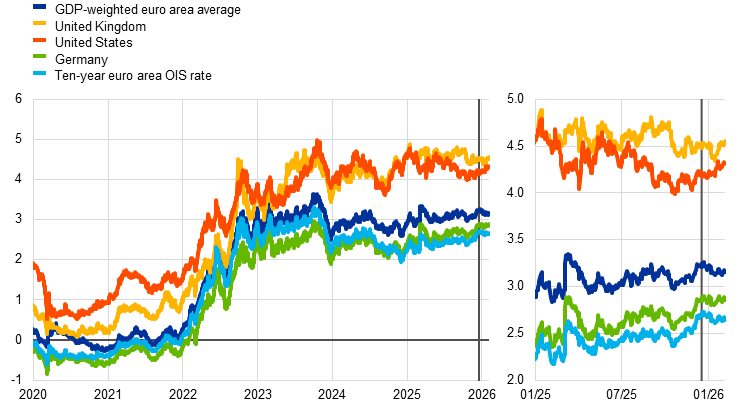
Euro area sovereign yield spreads held broadly steady and continued to be underpinned by improved fundamentals and robust demand for higher-yield sovereigns (Chart 13). The ten-year GDP-weighted euro area sovereign bond yield edged down by 5 basis points over the review period, while ten-year euro area sovereign bond spreads relative to risk-free OIS rates remained broadly stable. Geopolitical tensions and trade uncertainty contributed to market volatility. However, this turbulence, along with the upward repricing of Japanese long-dated government bonds, had only a limited impact on euro area sovereigns, which continued to be supported by resilient economic data and healthy demand for higher-yield sovereigns. Over the review period, French sovereign yields recorded the largest decline among the major euro area countries, falling by around 10 basis points amid easing political uncertainty. Overall, cross-country dispersion in euro area sovereign yields remains at historically low levels. Outside the euro area, the ten-year US Treasury yield rose by 16 basis points over the review period to stand at 4.3%, while the ten-year UK sovereign bond yield increased by 7 basis points to 4.6%.
Chart 13
Ten-year sovereign bond yields and the ten-year OIS rate based on the €STR
(percentages per annum)
Sources: LSEG and ECB calculations.
Notes: The vertical grey line denotes the start of the review period on 18 December 2025. The latest observations are for 4 February 2026.
Euro area equity prices increased during the review period, despite temporary drops caused by geopolitical tensions and trade uncertainty. Equity markets on both sides of the Atlantic recorded a sharp sell-off at the peak of these frictions, before rebounding as the tensions eased somewhat. Overall, euro area stock market indices increased by 4.5% during the review period, with stocks in financial firms and non-financial corporations (NFCs) rising by 4.9% and 3.8% respectively. Elevated geopolitical tensions continued to boost defence sector stocks, which recorded strong gains. Equities in sectors benefiting from higher capital expenditure, such as telecommunications and utilities, also outperformed their peers, underpinned by expectations of higher investment in infrastructure and artificial intelligence. US equity markets strengthened by around 1.5% over the review period, with gains of 1.6% for NFCs and 0.2% for financial corporations.
Euro area corporate bond spreads remained at compressed levels from a historical perspective and narrowed slightly further over the review period. Spreads in the investment-grade and high-yield segments tightened by 5 and 11 basis points respectively. In the investment-grade segment, NFC bond spreads narrowed by 5 basis points, while financial bond spreads tightened by 7 basis points. In the high-yield segment, spreads tightened by 10 basis points for NFCs and 14 basis points for financial corporations.
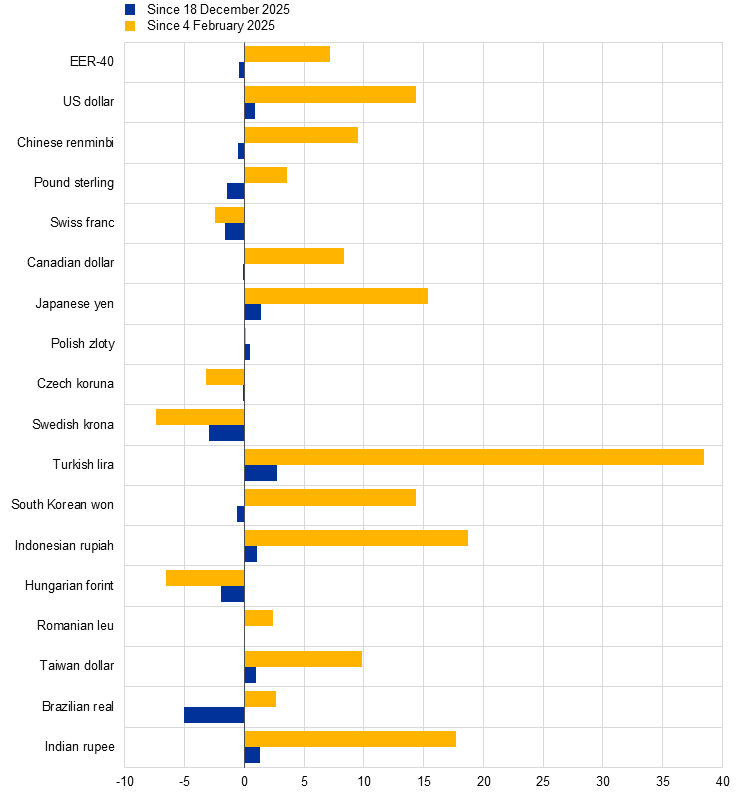
In foreign exchange markets, the euro appreciated slightly against the US dollar but weakened slightly on a trade-weighted basis (Chart 14). During the review period, the nominal effective exchange rate of the euro – as measured against the currencies of 40 of the most important trading partners of the euro area – weakened slightly (-0.4%). The euro appreciated slightly (+0.9%) against the US dollar, temporarily reaching its highest level since mid-2021, on the back of geopolitical tensions and trade uncertainties. Across major and emerging market currencies, the euro depreciated slightly against the Chinese renminbi (-0.6%) and also fell against the pound sterling (-1.5%), amid improved macroeconomic performance in the United Kingdom, and the Swiss franc (-1.6%), reflecting the franc’s continued safe-haven status. These moves were partly offset by an appreciation against the Japanese yen (+1.4%) owing to domestic political developments in Japan.
Chart 14
Changes in the exchange rate of the euro vis-à-vis selected currencies
(percentage changes)
Source: ECB calculations.
Notes: EER-40 is the nominal effective exchange rate of the euro against the currencies of 40 of the most important trading partners of the euro area. A positive (negative) change corresponds to an appreciation (depreciation) of the euro. All changes have been calculated using the foreign exchange rates prevailing on 4 February 2026.
5 Financing conditions and credit developments
Bank lending rates for firms and households have been broadly stable since the summer, against the backdrop of unchanged ECB policy rates. In December 2025 average interest rates on new loans to firms ticked up to 3.6%, while rates on new mortgages held steady at 3.3%. Growth in loans to households continued its upward trend, while growth in loans to firms remained broadly unchanged. Over the review period from 18 December 2025 to 4 February 2026, the cost of market-based debt decreased, while that of equity financing remained virtually unchanged. According to the January 2026 euro area bank lending survey, banks tightened credit standards for loans to firms in the fourth quarter of 2025, while demand for new loans to firms continued to edge up. Credit standards for housing loans eased slightly and those for consumer credit tightened further, while the demand for housing loans continued to increase moderately. Trade tensions and related uncertainty added to tighter credit standards. In the Survey on the Access to Finance of Enterprises for the fourth quarter of 2025, which was conducted between 19 November and 15 December 2025, firms reported an increase in bank interest rates as well as a continued tightening of other lending conditions. The annual growth rate of broad money (M3) decreased to 2.8% in December.
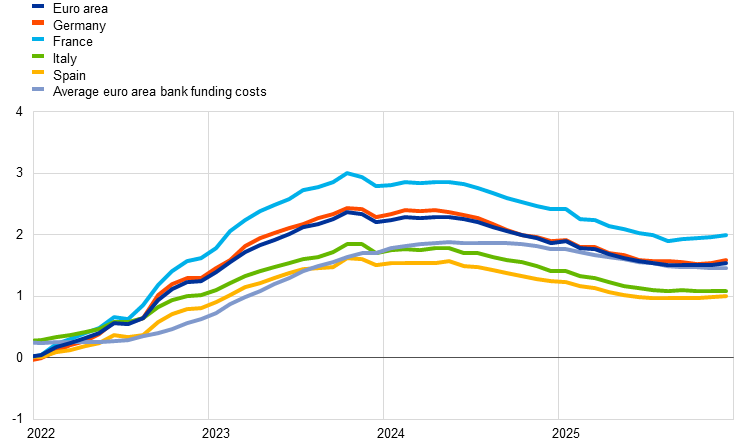
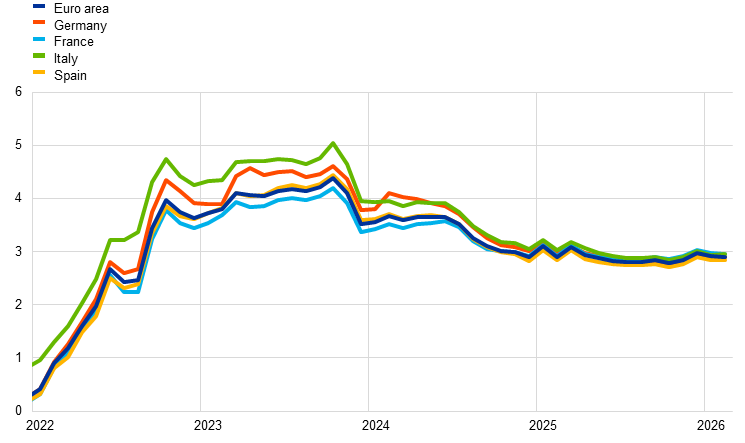
Bank funding costs remained broadly stable in December 2025. The composite cost of debt financing for euro area banks stood at 1.5% in December (Chart 15, panel a). According to data available at the beginning of February 2026, bank bond yields – which had edged up in December – declined to slightly below 3%, broadly in line with the wider trend seen since the beginning of 2025 and mirroring developments in longer-term risk-free rates (Chart 15, panel b). Interest rates on overnight deposits and deposits redeemable at notice saw little change in December, as did interbank rates, while rates on time deposits for firms and households increased slightly. The gap between interest rates on time deposits and overnight deposits was broadly unchanged in December for both firms and households. The composite deposit rate remained stable at 0.9%, around 50 basis points below its May 2024 peak.
Chart 15
Composite bank funding costs in selected euro area countries
a) Banks’ composite cost of debt financing
(annual percentages)
b) Bank bond yields
(annual percentages)
Sources: ECB, S&P Dow Jones Indices LLC and/or its affiliates, and ECB calculations.
Notes: Composite bank funding costs are an average of new business costs for overnight deposits, deposits redeemable at notice, time deposits, bonds and interbank borrowing, weighted by their respective outstanding amounts. Average bank funding costs use the same weightings but are based on rates for outstanding deposits and interbank funding, and on yield to maturity at issuance for bonds. Bank bond yields are monthly averages for senior tranche bonds. The latest observations are for December 2025 for the composite cost of debt financing for banks (panel a) and 4 February 2026 for bank bond yields (panel b).
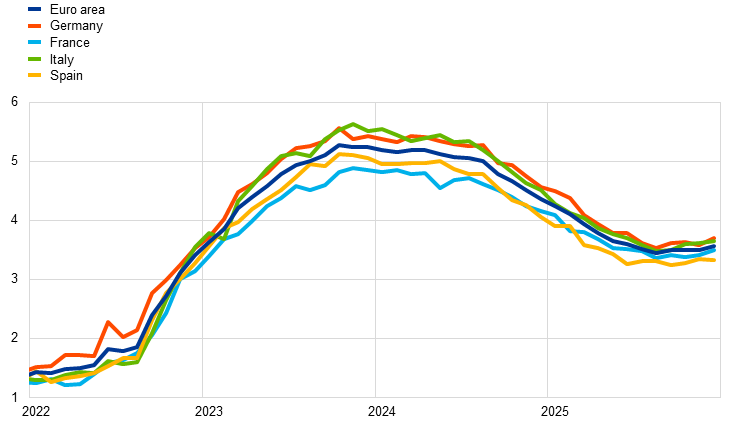
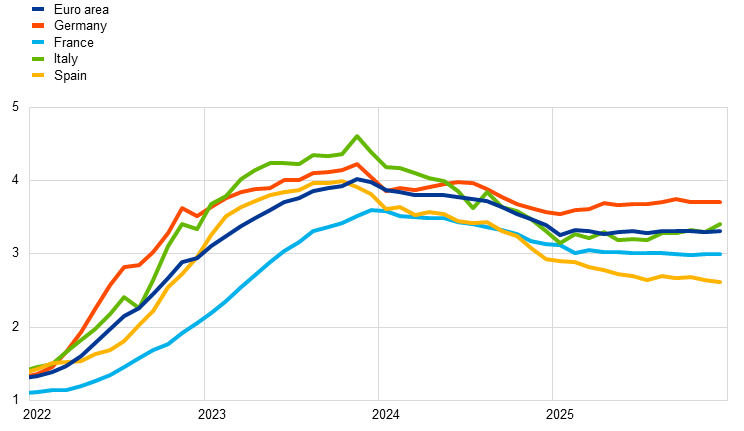
Bank lending rates for firms increased in December, while those for households remained broadly stable. The cost of bank borrowing for non-financial corporations (NFCs) ticked up to 3.6% in December, after 3.5% in November, around 1.7 percentage points down from its October 2023 peak. The increase was widespread across the larger euro area countries (Chart 16, panel a). It is also broadly consistent with data from the January 2026 euro area bank lending survey, in which banks reported a tightening of terms and conditions for loans to firms in the fourth quarter of 2025, especially for lending rates. Across fixation periods, the increase in financing costs came from short-term loans (below one year) and long-term loans (over five years). The spread between interest rates on small and large loans to firms narrowed significantly in December. This narrowing was broad-based across the largest euro area countries and was mostly driven by increases in interest rates on large corporate loans. The cost of borrowing for households for house purchase was unchanged at 3.3% in December, around 70 basis points below its November 2023 peak, with some variation across the larger euro area countries (Chart 16, panel b). The gap between lending rates for households and those for firms currently stands at 25 basis points, having narrowed considerably since its peak of 140 basis points in March 2024. The positive gap mainly reflects the fact that loans to households tend to have longer rate fixation periods in many euro area countries. This makes them more sensitive to longer-term market rates, which are higher than the shorter-term market rates that matter most for lending to firms.
Chart 16
Composite bank lending rates for firms and households in selected euro area countries
a) Rates on loans to NFCs
(annual percentages)
b) Rates on loans to households for house purchase
(annual percentages)
Sources: ECB and ECB calculations.
Notes: Composite bank lending rates are calculated by aggregating short and long-term rates using a 24-month moving average of new business volumes. The latest observations are for December 2025. In panel a), NFCs stands for non-financial corporations.
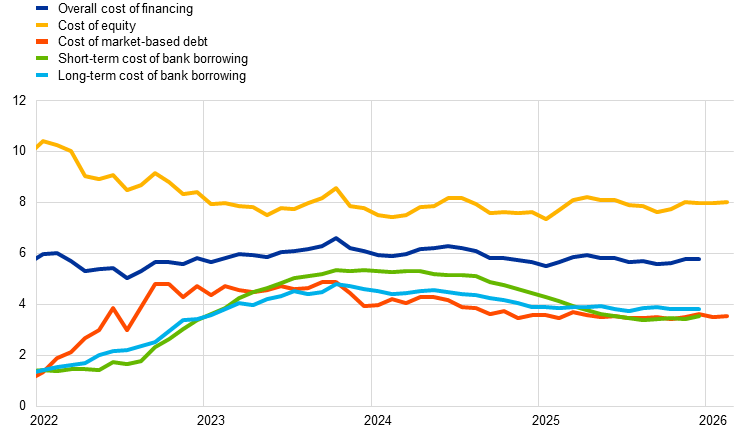
Over the review period from 18 December 2025 to 4 February 2026, the cost of market-based debt declined while the cost of equity financing remained virtually unchanged, following modest increases in November 2025. The overall cost of financing for NFCs – the composite cost of bank borrowing, market-based debt and equity – was 5.8% in December, the same as in November and up from 5.6% in October (Chart 17).[6] This reflected the higher cost of equity financing and market-based debt as well as an increase in bank borrowing costs. Daily data for the review period from 18 December 2025 to 4 February 2026 show downward movements in the cost of market-based debt, with virtually no change in the cost of equity. The reduction in the cost of market-based debt was driven by the downward shift in risk-free rates and a decline in corporate bond spreads.
Chart 17
Nominal cost of external financing for euro area firms, broken down by component
(annual percentages)
Sources: ECB, Eurostat, Dealogic, Merrill Lynch, Bloomberg Finance L.P., LSEG and ECB calculations.
Notes: The overall cost of financing for non-financial corporations is based on monthly data and is calculated as a weighted average of the long and short-term costs of bank borrowing (monthly average data), market-based debt and equity (end-of-month data), determined by their respective outstanding amounts. The latest observations are for 4 February 2026 for the cost of market-based debt and the cost of equity (daily data) and December 2025 for the overall cost of financing and the cost of borrowing from banks (monthly data).
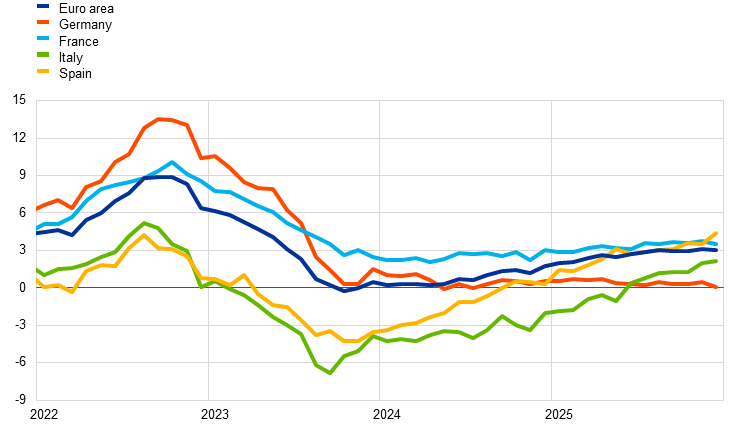
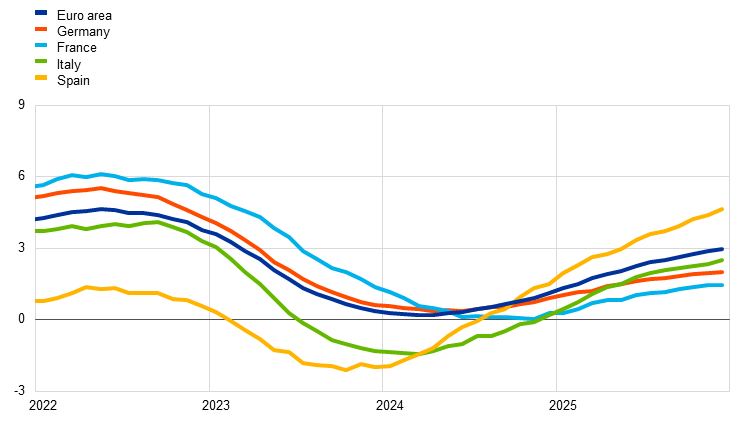
Growth in loans to households continued its upward trend, while growth in loans to firms remained broadly unchanged in December. The annual growth rate of bank lending to firms saw a marginal decline to 3.0% in December 2025, after 3.1% in November, still well below its historical average of 4.3% (Chart 18, panel a). Annual growth in corporate debt financing remained unchanged at 3.2% in December. Loans to households continued to gradually recover, as the annual growth rate rose to 3.0% in December from 2.9% in November, also remaining well below its historical average of 4.1% (Chart 18, panel b). Loans to households for house purchase increased further, while consumer credit growth weakened. Other forms of lending to households, including loans to sole proprietors, remained subdued. According to the most recent ECB Consumer Expectations Survey, households perceived credit access to be easier in December, and expected this trend to continue over the next 12 months. The still relatively slow growth in loans partly reflects higher uncertainty about global economic policies. This factor was prominent in the first half of 2025 and has become important again in the wake of recent trade policy developments in the United States and elevated geopolitical risks.[7]
Chart 18
MFI loans in selected euro area countries
a) MFI loans to NFCs
(annual percentage changes)
b) MFI loans to households
(annual percentage changes)
Sources: ECB and ECB calculations.
Notes: Loans from monetary financial institutions (MFIs) are adjusted for loan sales and securitisation; in the case of non-financial corporations (NFCs), loans are also adjusted for notional cash pooling. The latest observations are for December 2025.
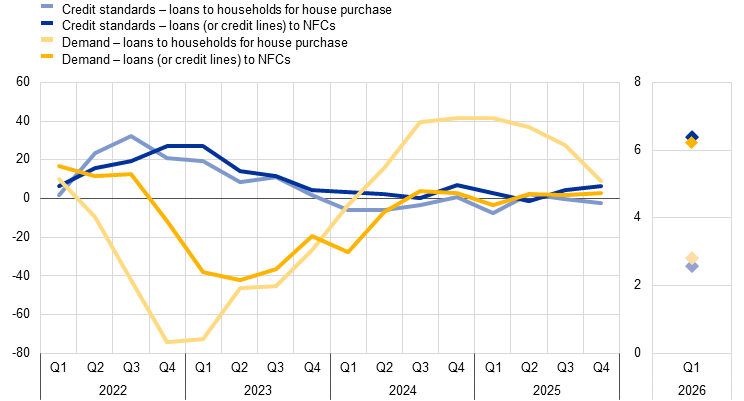
The January 2026 euro area bank lending survey reports a net tightening of credit standards for loans to firms in the fourth quarter of 2025 and a small net easing of credit standards for housing loans (Chart 19). The unexpected tightening of credit standards for loans or credit lines to euro area firms was mainly driven by higher perceived risks to the economic outlook and lower bank risk tolerance. While the tightening is consistent with a high degree of risk aversion by banks, the survey period ended on 13 January, i.e. before the 17 January announcement of additional US tariffs on imports from selected European countries (revoked on 21 January). Credit standards for housing loans eased slightly and those for consumer credit tightened further in the fourth quarter of 2025. For housing loans, competition had an easing impact on credit standards, while risk perceptions had a tightening impact. The lower risk tolerance and higher risk perceptions of banks were the main drivers of the tightening for consumer credit. Banks reported a net increase in the proportion of rejected applications for loans to firms and consumer credit, and an unchanged share for housing loans. For the first quarter of 2026, euro area banks expect credit standards to tighten moderately for loans to firms, to tighten slightly for housing loans and to tighten markedly for consumer credit.
Chart 19
Changes in credit standards and net demand for loans to NFCs and loans to households for house purchase
(net percentages of banks reporting a tightening of credit standards or an increase in loan demand)
Source: ECB (bank lending survey).
Notes: NFCs stands for non-financial corporations. For survey questions on credit standards, “net percentages” are defined as the difference between the sum of the percentages of banks responding “tightened considerably” and “tightened somewhat” and the sum of the percentages of banks responding “eased somewhat” and “eased considerably”. For survey questions on demand for loans, “net percentages” are defined as the difference between the sum of the percentages of banks responding “increased considerably” and “increased somewhat” and the sum of the percentages of banks responding “decreased somewhat” and “decreased considerably”. The diamonds denote expectations reported by banks in the current round. The latest observations are for the fourth quarter of 2025.
In the survey banks reported that, in the fourth quarter of 2025, the demand for loans to firms increased slightly and housing loan demand grew at a solid yet moderating pace. The increase in demand for loans to firms was similar to that recorded in the previous quarter. It was mainly driven by greater demand for inventories and working capital and increased financing needs for debt refinancing or debt restructuring, while the level of interest rates also supported loan demand. The demand for housing loans increased further, albeit more moderately than in the previous quarter. This primarily reflected improved housing market prospects. The demand for consumer credit decreased slightly in the fourth quarter and was somewhat lower than banks had expected, following broadly unchanged demand in the third quarter. Lower consumer confidence dragged down consumer credit demand, while interest rates had a positive effect on demand. For the fourth quarter of 2025, banks expect a further increase in demand for loans to firms and a small increase in the demand for both housing loans and consumer credit.
According to the responses of banks to the ad hoc questions, perceived risks to credit quality continued to weigh on credit standards, while trade tensions and related uncertainty added to tighter credit standards and dampened loan demand. In the fourth quarter of 2025, the ability of banks to access to retail funding and money markets deteriorated slightly, while access eased for debt securities and securitisation. Banks expect access to retail and money market funding and securitisation markets to remain broadly unchanged over the next three months, while they expect access to debt securities funding to improve slightly. Supervisory and regulatory measures contributed to an increase in required capital and holdings of liquid assets of banks. This in turn contributed to a tightening of credit standards across all loan categories, with further net tightening expected for 2026. Banks also reported that non-performing loan ratios and other credit quality indicators had a small net tightening impact on their credit standards for all loan categories in the fourth quarter of 2025. For the first quarter of 2026, euro area banks expect credit quality to have a further small tightening impact on their loans to firms and for consumer credit, while they expect a broadly neutral impact for housing loans. Credit standards tightened in construction, wholesale and retail trade, energy-intensive manufacturing and commercial real estate in the second half of 2025, with the net tightening being strongest in manufacturing of motor vehicles. Loan demand decreased in net terms in non-financial services other than commercial real estate and remained stable or declined slightly in other sectors. For the first half of 2026, banks expect either a further tightening or broadly unchanged credit standards across the main economic sectors, and an increase in loan demand for most sectors with the exceptions of manufacturing of motor vehicles, wholesale and retail trade, and commercial real estate. Based on a new question on the impact of changes in trade policies and related uncertainty, almost half of the surveyed banks assessed their exposure to these changes as “important”. Banks reported that the tensions have had a tightening impact on credit standards, mostly through a decrease in risk tolerance, and a dampening impact on demand for loans to firms. They also expect a similar impact for 2026.
In the latest Survey on the Access to Finance of Enterprises (SAFE), conducted between 19 November and 15 December 2025, firms reported a tightening in bank lending conditions amid increases in loan interest rates. In the fourth quarter of 2025 a net 12% of firms reported an increase in bank interest rates, compared with a net 2% in the previous quarter. Large firms and small and medium-sized enterprises (SMEs) reported similar perceptions regarding the increase in interest rates. Firms also indicated a further net tightening of other loan conditions, particularly for other financing costs, such as charges, fees and commissions, and collateral requirements.
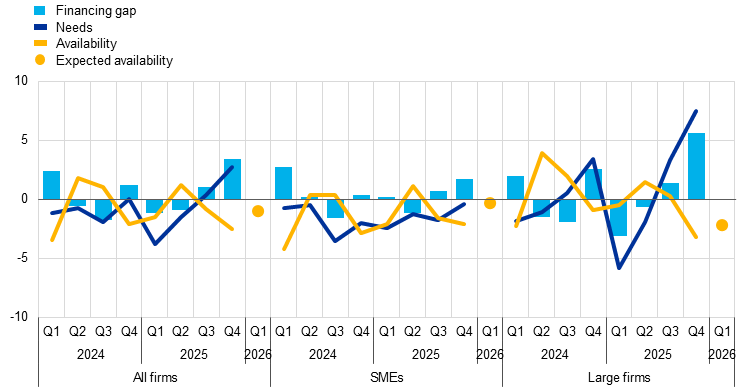
Firms reported a modest rise in their needs for bank loans, accompanied by a small perceived decline in availability (Chart 20). In the fourth quarter of 2025, firms indicated slightly higher needs for bank loans (a net 3% compared with 0% in the previous quarter). This increase was driven by large firms, while SMEs reported broadly unchanged needs. The net percentage of firms reporting a decline in the availability of bank loans was 2%, compared with 1% in the previous quarter, with this trend observed across both SMEs and large firms. The bank loan financing gap indicator – an index capturing the difference between changes in needs and availability – widened to a net 3% (up from 1% in the previous quarter). Looking ahead, firms expect the availability of external financing to remain broadly unchanged over the next three months, as they did in the previous quarter.
Chart 20
Changes in needs of euro area firms for loans, current and expected bank loan availability and financing gap
(net percentages of respondents)
Sources: ECB (SAFE) and ECB calculations.
Notes: SMEs stands for small and medium-sized enterprises. Net percentages are the difference between the percentage of firms reporting an increase in availability of bank loans (or needs and expected availability respectively) and the percentage reporting a decrease in availability in the past three months. The indicator of the perceived change in the financing gap takes a value of 1 (-1) if the need increases (decreases) and availability decreases (increases). If firms perceive only a one-sided increase (decrease) in the financing gap, the variable is assigned a value of 0.5 (-0.5). A positive value for the indicator points to a widening of the financing gap. Values are multiplied by 100 to obtain weighted net balances in percentages. Expected availability has been shifted forward by one period to allow a direct comparison with realisations. The figures refer to rounds 30 to 37 of the SAFE (January-March 2024 to October-December 2025).
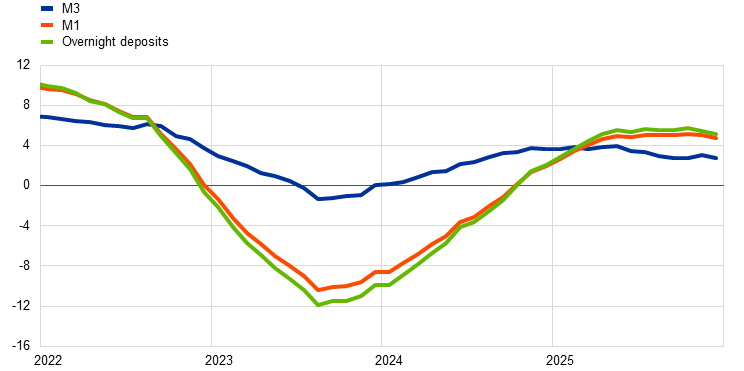
The annual growth rate of broad money (M3) slowed in December, remaining well below historical averages (Chart 21). It decreased to 2.8% in December after an uptick to 3.0% in November, reflecting a continuation of the modest pace of M3 growth observed throughout 2025 and remaining well below the long-term average of 6.1%. Annual growth in narrow money (M1), which comprises the most liquid components of M3, decreased to 4.7% in December from 5.0% in November. M1 growth continued to be driven by overnight deposits, reflecting a strong preference for liquid assets among firms and households. From a counterpart perspective, the main contributors to money creation in December were loans to households and firms and, to a lesser extent, net foreign monetary inflows, which have become more volatile recently and appear to have lost strength compared with 2024. Bank purchases of longer-term government bonds, as well as the ongoing reduction of the Eurosystem balance sheet with a passive runoff of the asset purchase programme and pandemic emergency purchase programme portfolio, continued to weigh negatively on M3 growth.
Chart 21
M3, M1 and overnight deposits
(annual percentage changes, adjusted for seasonal and calendar effects)
Source: ECB.
Note: The latest observations are for December 2025.
1 Global trade redirection: tracking the role of trade diversion from US tariffs in Chinese export developments
Prepared by Julien Le Roux and Tajda Spital
Global trade flows were reshaped in 2025 following the introduction of new US tariffs. US import growth weakened sharply, reflecting a strong decline in imports from China. Meanwhile, Chinese exports have surprised to the upside overall, with broad-based growth across destinations outside the United States. A key question is whether this resilience reflects trade diversion in response to the US tariffs, i.e. the reallocation of exports originally destined for one market towards alternative markets, or other adjustment mechanisms, such as rerouting through intermediary countries. However, it may still be too early to assess the full extent of tariff-induced trade redirection, as anticipatory behaviour, implementation lags at customs, shipping delays and other factors can all affect how long it takes for tariff changes to be reflected in observed trade flows. This box reviews developments in Chinese exports in 2025 and provides initial empirical evidence on whether US tariffs have triggered trade diversion.
More2 Drivers of electricity prices across households and energy-intensive industries and their importance for the EU’s decarbonisation objectives
Prepared by Daniela Arlia and John Hutchinson
Electrification is central to the EU’s decarbonisation strategy, yet electricity demand has remained broadly stagnant over the past decade, with prices remaining elevated after the 2021-22 energy crisis (Chart A). The European Commission’s Clean Industrial Deal, launched in February 2025, aims to increase the share of electricity in the EU’s gross final energy consumption from 23% in 2024 to 32% by 2030. Since electricity can be more readily generated from renewable sources compared with other forms of energy, increasing its share in final energy consumption is central to achieving the targets set in the EU’s Renewable Energy Directive. However, reaching this consumption target could be challenging, as electricity consumption in the euro area decreased by 6.3% between 2015 and 2023 (Eurostat, 2026).[8] At the same time, electricity prices remain elevated compared with levels before the 2021-22 energy crisis, though there is substantial variation across EU Member States and between households and firms. High electricity prices directly affect households by reducing purchasing power, while also having an impact on the competitiveness of energy-intensive firms. This box examines the composition of energy prices, the factors driving price differences, as well as recent consumption patterns in the five largest euro area countries, focusing on households and energy-intensive industries.
More3 Consumption and saving amid uncertainty: recent insights from the CES
Prepared by Maria Dimou, Maarten Dossche, Teresa Hütten and Georgi Kocharkov
Consumers’ perceptions of economic uncertainty play a critical role in shaping their spending and saving behaviour. Beyond its notable impact on aggregate demand, the effect of uncertainty on household decisions varies significantly across individual households.[9] In this context, the ECB Consumer Expectations Survey (CES) offers unique insights by providing timely and granular measures of uncertainty. This box first uses a measure of implied uncertainty based on an existing question in the CES about the probabilistic distribution of the expected income growth of households to assess the evolution of uncertainty over time.[10] It then combines information from a new question in the survey about the degree of perceived predictability of the financial situation of households. The survey also includes a follow-up question about their planned response to such economic uncertainty, making it possible to assess cross-household heterogeneity.[11]
More4 The fundamental drivers of recent developments in euro area housing investment
Prepared by Johannes Gareis
Euro area housing investment appears to have bottomed out, but a sustained recovery has yet to emerge. After increasing noticeably from mid-2015 to early 2022 – with a brief interruption during the COVID-19 pandemic-related downturn – housing investment declined relatively steadily from the first quarter of 2022 before reaching a trough in the fourth quarter of 2024 (Chart A). Although it picked up somewhat in early 2025, momentum has remained subdued. Housing investment declined by 0.2% in the third quarter of 2025 compared with the previous quarter, standing around 7% below its peak in the first quarter of 2022. Between the first quarter of 2022 and the third quarter of 2025, developments differed markedly across euro area countries. Among the largest euro area economies, such as Germany and France, housing investment declined substantially, while it increased in Italy and Spain.[12] This box uses a structural empirical model to decompose recent developments in euro area housing investment into their fundamental drivers and discusses the short-term outlook for housing investment growth.[13]
More5 Main findings from the ECB’s recent contacts with non-financial companies
Prepared by Gabe de Bondt, Richard Morris and Moreno Roma
This box summarises the main findings from recent contacts between ECB staff and representatives of 79 leading non-financial companies operating in the euro area. The exchanges took place between 5 and 14 January 2026.[14]
Contacts reported gradually increasing business momentum and confidence in recent months (Chart A and Chart B). Growth continued to be driven primarily by services activity, whereas reports in relation to industrial activity were mixed. Physical investment was picking up, but high energy, labour and regulatory costs still weighed on manufacturing amid intensifying competition, causing euro area firms to lose market shares in domestic and foreign markets. Varying labour and energy costs also helped to explain intra-euro area growth differentials.
More6 Estimating the time-varying reserve elasticity of money market rates in the euro area
Prepared by Flavia Ungarelli and Thomas Kostka
Understanding the demand for central bank reserves by commercial banks is important for the implementation of monetary policy. If the supply of central bank reserves increases relative to demand, money market rates will decline, up to the point where the most attractive option for banks is to deposit reserves with the central bank. If the demand for central bank reserves increases relative to supply, money market rates will rise, up to the point where the most attractive option for banks to satisfy their demand is to borrow from the central bank. Hence, the relation between central bank reserves and money market rates is non-linear: it is broadly flat around the respective central bank lending and deposit rates when reserves in the system are low or high and it slopes downwards when there are intermediate quantities of reserves. A stylised representation of this pattern is shown in Chart A. For central banks to gauge the elasticity of money market rates to changing central bank liquidity conditions, it is therefore relevant to have reliable estimates of the slope of this relation.
More1 Overcoming structural barriers to the green transition
Prepared by Miles Parker and Susana Parraga Rodriguez
The impact of climate change is becoming increasingly evident in Europe, underlining the imperative to reach net zero carbon emissions. Global temperatures are continuing to rise, with 2024 being the first year in which global temperatures exceeded 1.5°C above pre-industrial levels (World Meteorological Organization, 2025). Since 1980, the four worst years for physical damage (in real terms) caused by extreme weather and climate events in Europe were 2021, 2022, 2023 and 2024 (European Environment Agency, 2025). These events have also had an impact on inflation, notably food prices. For example, following severe droughts in Spain and Italy, olive oil prices were 50% higher in January 2024 than a year before (Kotz et al., 2025).
More https://www.ecb.europa.eu/pub/pdf/ecbu/ecb.eb_annex202601~1994d17195.en.pdf© European Central Bank, 2026
Postal address 60640 Frankfurt am Main, Germany
Telephone +49 69 1344 0
Website www.ecb.europa.eu
All rights reserved. Reproduction for educational and non-commercial purposes is permitted provided that the source is acknowledged.
For specific terminology please refer to the ECB glossary (available in English only).
The cut-off date for the statistics included in this issue was 4 February 2026.
PDF ISSN 2363-3417, QB-01-26-057-EN-N
HTML ISSN 2363-3417, QB-01-26-057-EN-Q
Legal Disclaimer:
EIN Presswire provides this news content "as is" without warranty of any kind. We do not accept any responsibility or liability for the accuracy, content, images, videos, licenses, completeness, legality, or reliability of the information contained in this article. If you have any complaints or copyright issues related to this article, kindly contact the author above.
