

Mobile Virtual Network Operator Market to Reach US$169.2 Billion by 2033, Growing at a CAGR of 7.8%
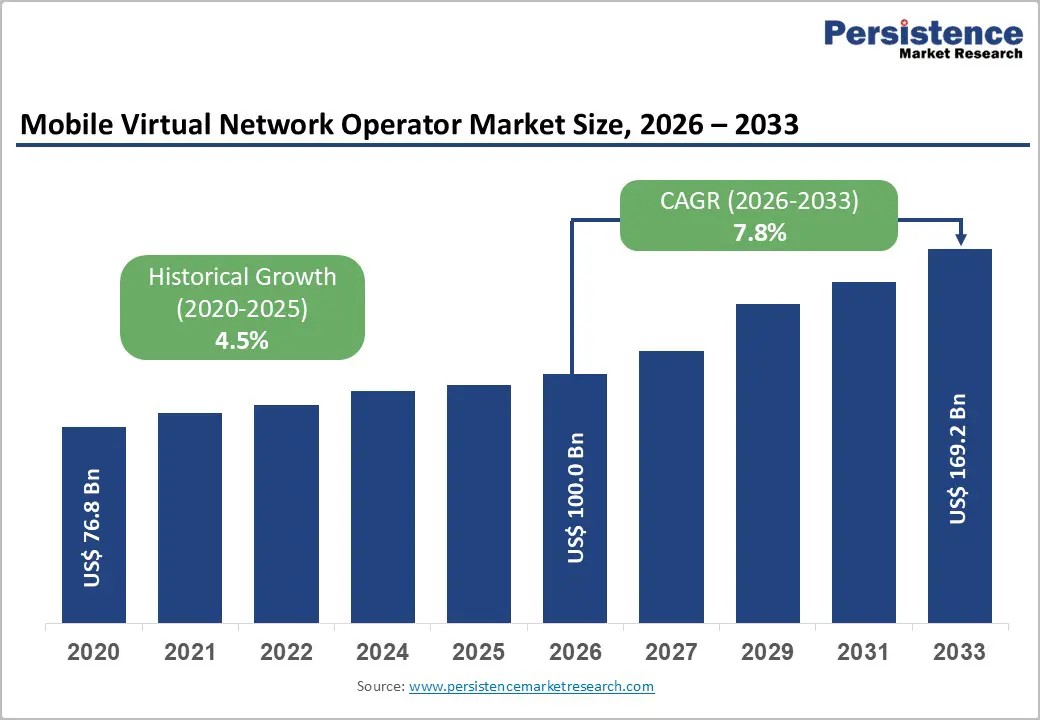
The mobile virtual network operator market to reach US$169.2 billion by 2033, growing at a 7.8% CAGR driven by flexible mobile services and digital adoption
BRENTFORD, ENGLAND, UNITED KINGDOM, June 3, 2026 /EINPresswire.com/ -- The global Mobile Virtual Network Operator (MVNO) market is witnessing steady expansion as telecom ecosystems shift toward flexible, digital-first, and cost-efficient connectivity models. The market is projected to be valued at US$100.0 billion in 2026 and is expected to reach US$169.2 billion by 2033, growing at a CAGR of 7.8%. This growth is primarily fueled by rising smartphone penetration, surging mobile data consumption, and increasing consumer preference for prepaid and contract-free mobile services across both developed and emerging economies.
Another key growth catalyst is the rapid expansion of 5G networks and IoT ecosystems, which is reshaping enterprise connectivity demand. MVNOs are increasingly leveraging wholesale access from Mobile Network Operators (MNOs) to deliver customized services for consumers and enterprises without owning spectrum infrastructure. North America leads the MVNO market with a 35% share, driven by strong regulatory frameworks and advanced telecom infrastructure, while the consumer segment dominates with nearly 60% share, supported by demand for affordable, flexible, and prepaid mobile plans across price-sensitive user bases.
𝐆𝐞𝐭 𝐚 𝐒𝐚𝐦𝐩𝐥𝐞 𝐏𝐃𝐅 𝐁𝐫𝐨𝐜𝐡𝐮𝐫𝐞 𝐨𝐟 𝐭𝐡𝐞 𝐑𝐞𝐩𝐨𝐫𝐭: https://www.persistencemarketresearch.com/samples/14203
Market Segmentation Analysis
The MVNO market is segmented based on operational model, subscriber type, service offerings, and application areas. By operational model, Full MVNOs dominate the market as they provide greater control over billing, customer experience, and service customization. Their ability to manage core network functions enables stronger brand differentiation and improved profit margins, especially in mature telecom markets. Meanwhile, light and hybrid MVNO models are gaining traction due to lower capital requirements and faster time-to-market advantages, making them highly attractive to digital-first brands and niche service providers.
By subscriber type, the consumer segment leads the market due to strong demand for prepaid and low-cost mobile plans, particularly in emerging economies. However, the enterprise segment is growing rapidly, driven by rising demand for IoT connectivity, fleet management, and corporate mobility solutions. From a service perspective, prepaid offerings dominate due to their flexibility and affordability, while postpaid and bundled digital services are expanding quickly with the rise of 5G, entertainment bundles, and value-added digital subscriptions. Application-wise, cellular M2M leads the market, while consumer mobile broadband is emerging as the fastest-growing segment due to increasing video streaming, gaming, and mobile data consumption.
Regional Insights
North America remains the leading region in the MVNO market, driven by a mature telecom ecosystem, strong regulatory support, and widespread 5G deployment. The United States plays a central role, with MVNOs benefiting from wholesale access agreements and innovation-driven competition. Enterprises in the region are increasingly adopting MVNO solutions for IoT connectivity, enterprise mobility, and customized communication services, further strengthening market maturity.
Europe represents a highly regulated and competitive MVNO landscape, supported by strong wholesale access frameworks and cross-border connectivity reforms. Countries such as the UK, Germany, France, and Spain are key contributors to growth, with increasing adoption of digital-first MVNO models. Asia Pacific is emerging as the fastest-growing region, driven by massive subscriber bases in India and China, rising smartphone penetration, and expanding 4G and 5G infrastructure. Latin America and the Middle East & Africa are also witnessing gradual growth, supported by rising digital inclusion and expanding telecom infrastructure.
𝐃𝐨 𝐘𝐨𝐮 𝐇𝐚𝐯𝐞 𝐀𝐧𝐲 𝐐𝐮𝐞𝐫𝐲 𝐎𝐫 𝐒𝐩𝐞𝐜𝐢𝐟𝐢𝐜 𝐑𝐞𝐪𝐮𝐢𝐫𝐞𝐦𝐞𝐧𝐭? 𝐑𝐞𝐪𝐮𝐞𝐬𝐭 𝐂𝐮𝐬𝐭𝐨𝐦𝐢𝐳𝐚𝐭𝐢𝐨𝐧 𝐨𝐟 𝐑𝐞𝐩𝐨𝐫𝐭: https://www.persistencemarketresearch.com/request-customization/14203
Market Drivers
The MVNO market is primarily driven by the rising global demand for affordable and flexible mobile services. Consumers are increasingly shifting toward prepaid and no-contract mobile plans, especially in cost-sensitive markets where affordability is a key decision factor. MVNOs capitalize on wholesale agreements with MNOs to offer services at significantly lower prices, often 20–40% cheaper than traditional operators, making them highly attractive in both urban and rural markets.
Another major driver is the expansion of 5G and IoT ecosystems, which is unlocking new enterprise opportunities. With billions of IoT devices being deployed globally, businesses require scalable and flexible connectivity solutions that MVNOs are well-positioned to deliver. From smart logistics and connected vehicles to industrial automation and remote monitoring, MVNOs are becoming critical enablers of digital transformation across industries.
Market Restraints
Despite strong growth, the MVNO market faces structural challenges due to heavy dependence on host Mobile Network Operators (MNOs). This reliance limits operational control, exposes MVNOs to pricing fluctuations, and reduces service flexibility. Any network disruption or capacity limitation at the MNO level directly impacts MVNO service quality, creating operational risks and reliability concerns.
Another significant restraint is intense price competition and market saturation, particularly in developed regions. The low barrier to entry has led to overcrowded markets, resulting in aggressive pricing strategies that compress margins and increase customer churn. As services become commoditized, MVNOs struggle to differentiate beyond price, making long-term profitability increasingly challenging without niche positioning or value-added services.
Market Opportunities
The MVNO market presents strong opportunities in enterprise IoT and M2M connectivity, which is emerging as a high-margin growth segment. As industries increasingly adopt connected devices, MVNOs can provide scalable, customized connectivity solutions for logistics, automotive, utilities, and industrial automation. These enterprise-focused services often generate significantly higher margins than traditional consumer mobile plans.
Another key opportunity lies in international roaming and cross-border connectivity solutions. With a growing global migrant population and increasing workforce mobility, demand for affordable international calling and multi-country mobile plans is rising. MVNOs leveraging eSIM technology and digital-first platforms are well-positioned to serve expatriates, travelers, and remote workers, unlocking new recurring revenue streams in a rapidly globalizing digital economy.
𝐁𝐮𝐲 𝐍𝐨𝐰 𝐭𝐡𝐞 𝐃𝐞𝐭𝐚𝐢𝐥𝐞𝐝 𝐑𝐞𝐩𝐨𝐫𝐭: https://www.persistencemarketresearch.com/checkout14203
Company Insights
• Lyca Mobile
• Lebara Mobile
• Giffgaff
• TracFone Wireless
• Consumer Cellular
• Virgin Mobile
• Tesco Mobile
• Talkmobile
• PosteMobile
• Truphone
• DataXoom
• Boost Mobile
• KDDI Mobile
• Citic Telecom
• Exetel
Conclusion
The Mobile Virtual Network Operator (MVNO) market is growing steadily, driven by affordable mobile plans, digital transformation, and expanding 5G and IoT adoption. Despite challenges such as pricing pressure and reliance on host networks, strong opportunities in enterprise connectivity and international roaming are expected to support long-term market growth.
Related Reports:
Digital Experience Platform Market
Wireless Bluetooth Printer Market
Pooja Gawai
Persistence Market Research
+1 646-878-6329
email us here
Visit us on social media:
LinkedIn
Instagram
Facebook
YouTube
X
Legal Disclaimer:
EIN Presswire provides this news content "as is" without warranty of any kind. We do not accept any responsibility or liability for the accuracy, content, images, videos, licenses, completeness, legality, or reliability of the information contained in this article. If you have any complaints or copyright issues related to this article, kindly contact the author above.
